Auditing Accessibility Across a Cultural Institution
A recurring institutional audit can document barriers across programs, set transparent priorities, assign accountable owners, and verify changes across multiple programs—separate from guidance for one visitor’s event journey.
Publication & corrections: infostoa · Editorial standards
Individual author and specialist reviewer information is not provided for this article.
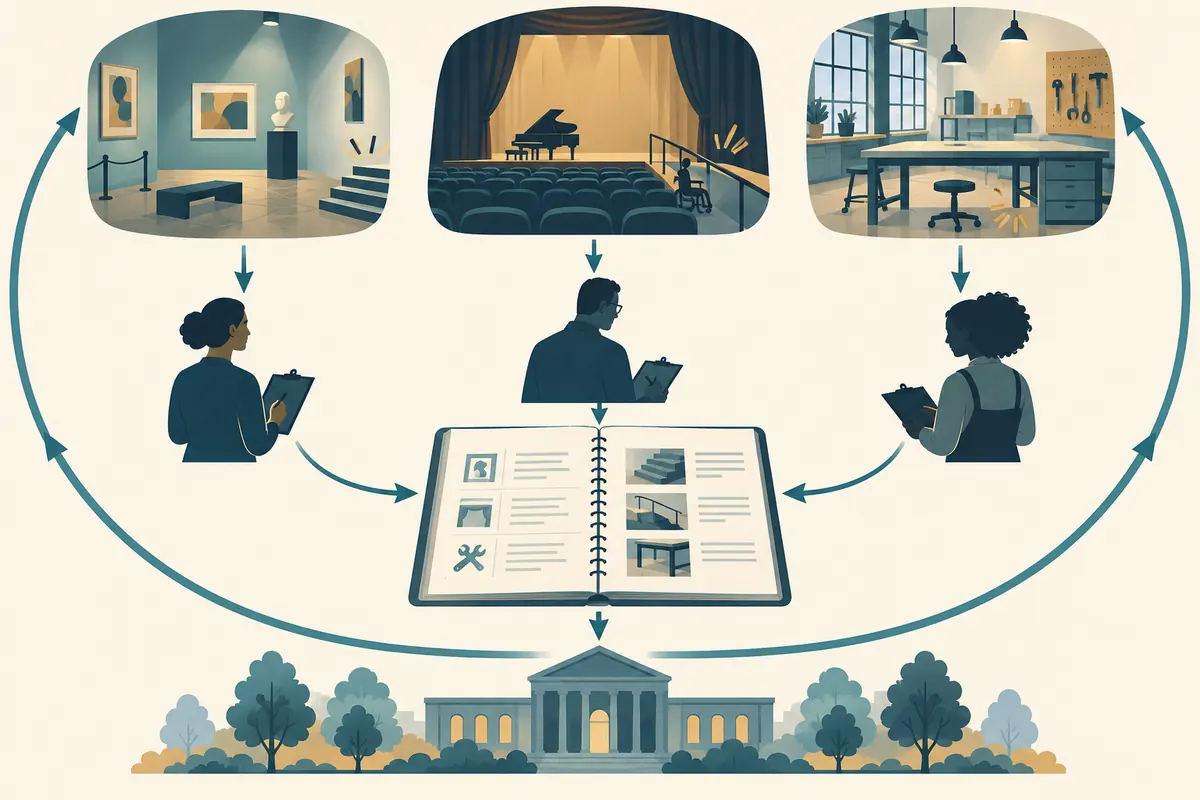
An institutional accessibility audit does more than inspect a ramp or seating area once. It records evidence of recurring barriers across programs and operating practices, then connects priorities to accountable owners and a date for checking the result. The National Endowment for the Arts (NEA) Section 504 Self-Evaluation Workbook helps NEA-supported organizations evaluate programs, activities, policies, and practices. Its stated compliance context is specific to that federal assistance program, not a universal legal checklist.
Set an institution-wide scope
A single-event access guide gives visitors information about one date, such as entrances, booking, seats, or on-site support. An institutional audit asks where barriers recur across exhibitions, performances, learning programs, web information, registration, and facilities—and who can change them. Fixing a seating arrangement for one event does not establish that the next program or another room works equally well.
List the areas the organization can inspect or influence: movement through facilities, online and printed information, participation formats, inquiry and booking processes, and staff procedures. For multiple sites, label what was reviewed, sampled, or not yet checked. A sample helps identify the next investigation; it cannot establish the frequency of barriers across the entire institution.
Record evidence that another person can verify
Replace a broad judgment such as “the program is inaccessible” with an observed condition. For example, the page did not identify a step-free entrance, a room layout limited wheelchair seating choices, or a registration form could not be completed with keyboard navigation alone. Record when and where it was observed, which program or process is affected, the evidence, and what remains uncertain. A baseline makes later comparison possible.
When collecting feedback, explain its purpose and use. Do not record diagnoses or personal circumstances without an appropriate need and consent. A few responses do not represent every visitor; note whose experience is still missing.
Make priority decisions transparent
If the institution cannot resolve every barrier at once, state how work will be sequenced. Flag possible legal obligations for review under the applicable local requirements. For other issues, compare the degree to which participation is restricted, how many programs or processes are affected, whether the problem recurs, implications for safety and dignity, interim options, and the staff time and budget required for a durable change.
If a scorecard helps teams discuss trade-offs, define its factors and record why an item was prioritized. The factors here are a proposed decision aid, not an official NEA or AAM scoring method. Do not total scores into a legal-compliance verdict or a claim about whether an individual can attend. Mark uncertain evidence and assign follow-up instead of presenting an estimate as fact.
A professional perspective: connect coordinators to shared accountability
The NEA workbook covers programs, activities, policies, and practices at organizations it supports, identifies a Section 504 coordinator to complete it, and says comparable evaluation information should be kept on file if the workbook is not used. The American Alliance of Museums (AAM) Excellence in DEAI Task Force separately recommends embedding accountability in operations and job descriptions at multiple levels. It treats assessment, reflection, capacity building, iteration, and measurement as continuing work and recognizes that institutions have different starting points and priorities.
A coordinator can maintain evidence and follow-up without owning every corrective action. Assign an entrance change to facilities, a booking barrier to the web or ticketing team, and a participation-format change to program staff—roles that have authority to act. For each finding, record the accountable role, collaborating teams, resources, target date, and a verifiable completion condition. This is an editorial operating proposal based on the sources, not an NEA or AAM form.
Recheck changes across programs and respect jurisdiction
After changing an online form, retest its keyboard path and check other program pages that use it. After altering a room, verify representative setups for multiple programs in that space. One successful test or a few favorable survey responses cannot prove a change works for everyone. Combine observable checks with voluntary feedback and note remaining gaps. Reopen relevant items when a new program, facility change, or booking process changes the conditions; recurring problems may call for different training, procedures, procurement rules, or budget.
The NEA workbook’s Section 504 context concerns NEA-supported organizations; it does not establish identical duties for every U.S. institution or any organization abroad. The AAM report is professional museum guidance, not a law or binding standard for all cultural institutions. Actual requirements depend on jurisdiction and institutional circumstances. Check applicable rules and seek qualified advice where needed. This audit framework helps track improvement; it does not determine legal compliance.