How Air Bubbles in Antarctic Ice Cores Preserve an Ancient Atmosphere
Learn how trapped air differs from ice-based climate proxies, what the Dome C CO2 record shows, and where age and interpretation limits matter.
Publication & corrections: infostoa · Editorial standards
Individual author and specialist reviewer information is not provided for this article.
An Antarctic ice core contains more than old ice. Air trapped in its bubbles can be analyzed to estimate the atmosphere’s carbon dioxide concentration at the time that air was sealed in. In a 2008 Nature study, Lüthi and colleagues extended the Dome C CO2 record to 800,000 years before present and reported a strong relationship between atmospheric CO2 and Antarctic temperature across eight glacial cycles. Reading that record well requires distinguishing the signal in the ice from the gas in the bubbles, and understanding what a dated core can and cannot represent.
Ice and bubbles preserve different evidence
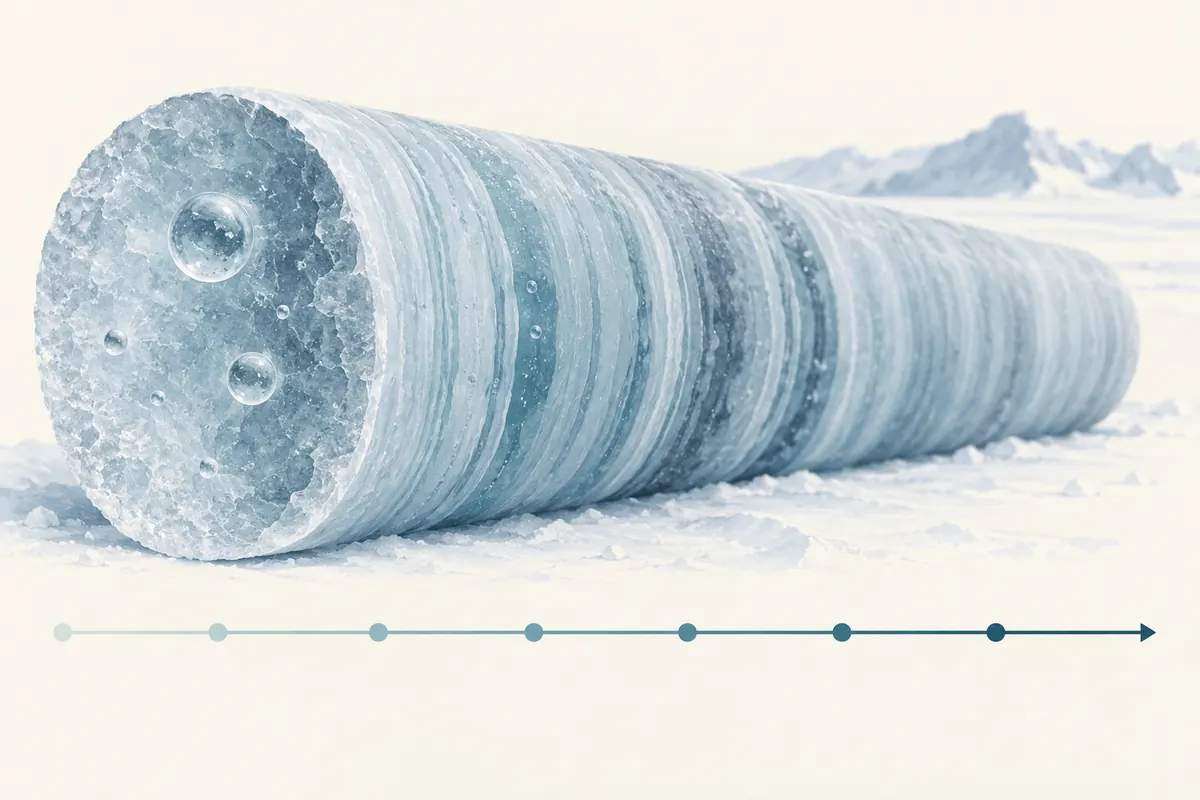
An ice core is a cylindrical sample recovered from accumulated ice. The ice itself can preserve proxy indicators such as oxygen isotopes, dust, and other chemical measurements that help reconstruct past climate and environmental conditions. Gas bubbles preserve samples of ancient air; analyzing their contents can provide measurements of gases such as carbon dioxide and methane. NOAA’s National Centers for Environmental Information (NCEI) maintains a paleoclimate archive of ice-core data from polar and mountain glaciers. Its catalogue includes measurements such as oxygen isotopes, methane, and dust and can be searched by study, investigator, location, or parameter.
“Direct measurement” here means measuring gas in a core sample, not observing the entire atmosphere everywhere at every moment. A core represents a particular site and depth. Researchers compare its age model and laboratory methods with other cores and climate proxies.
How air becomes enclosed in ice
Snow compacts and recrystallizes until some air is isolated in bubbles. Bubble gas and surrounding ice can have different ages, so researchers use accumulation, layers, isotopes, and other constraints rather than depth alone.
Deeper sections generally contain older material, but layers thin and may be deformed. There is no universal depth-to-year conversion for every core. Use the age range and uncertainty reported for the particular core and study.
A quick comparison: ice age versus gas age
| Age refers to | Reference | What it dates | What to watch for |
|---|---|---|---|
| Ice age | When the snow for that layer was deposited | Signals later preserved in the transformed ice, such as isotopes | Can be older than air enclosed at the same depth |
| Gas age | The mean age and age distribution of air trapped in sampled bubbles | A sample of past atmosphere, including CO2 or methane | Air mixes and exchanges in porous firn; trapping is gradual, not instantaneous |
Conceptual process: snow deposition → air movement, diffusion, and mixing within porous firn (snow compacting toward ice) → pores gradually close and trap air in bubbles. This is not a measured or dated timeline. The trapped air does not represent one instant; it can have an age distribution. Ice-core studies describe this using mean gas age and its difference from ice age (Δage), which depend on site conditions and the age model. Research on air mixing in firn and the age distribution of trapped air
What the Dome C study established
The 2008 Nature paper analyzed the lowest 200 meters of the EPICA Dome C core, extending an existing 650,000-year atmospheric CO2 record by two complete glacial cycles to 800,000 years before present. Across eight cycles, the authors reported that atmospheric CO2 was strongly correlated with Antarctic temperature. The work is a notable example of how trapped air can extend the atmospheric record far beyond direct instrumental observations.
It is not a continuous weather-station record of the global atmosphere at every place and time. It is a reconstruction based on gas measured from a specific Antarctic core and interpreted alongside other evidence. Detailed concentration ranges in the paper apply to its samples, dating framework, and late-Quaternary interval. Before comparing one of those values with a modern measurement, check the date, unit, preindustrial baseline, and time interval being discussed.
What correlation does and does not tell us
A CO2–temperature correlation shows that the variables changed together across the cycles studied; it does not establish exact timing or every causal pathway. Oceans, ice sheets, and circulation interact on different timescales, and dating uncertainty affects comparisons.
When comparing studies, ask three questions: Was the measurement made in the ice or in bubble air? Does the reported age refer to the ice or the gas? Is the result from one core or a synthesis of several records? Searching NOAA’s catalogue by study, investigator, location, and measured parameter can help locate the dataset description and prevent unlike indicators from being treated as interchangeable observations.
A practical way to read a core record
Start with the paper’s abstract and identify the core location and what was measured. Then inspect the dataset description for its age model, sample depth, units, and uncertainty. Compare the CO2 series with temperature proxies only after checking how age uncertainty affects their apparent timing. Older measurements may be revised or combined with additional cores, so do not treat one headline number as the final value for the whole field.
Air bubbles in Antarctic ice are valuable samples of past atmospheres, while the ice’s other indicators help describe the climate in which that air was trapped. The Dome C study shows that these samples can extend a CO2 record across hundreds of thousands of years. Accurate interpretation depends on keeping the site, age, proxy, and scope of each result visible.
NOAA NCEI’s World Data Service for Paleoclimatology says its archive holds ice-core data from polar and mountain glaciers and can be searched by investigator, title, location, and measured parameter. Checking those fields alongside each dataset’s age model and material helps distinguish records from different cores. NOAA NCEI Ice Core archive