HLA-B27, Enthesitis, and Spinal Fusion in Ankylosing Spondylitis
HLA-B27 is strongly associated with ankylosing spondylitis but is not a diagnosis. This guide separates the observed links among enthesitis, inflammation, and new bone formation from mechanisms that remain unresolved.
Publication & corrections: infostoa · Editorial standards
Individual author and specialist reviewer information is not provided for this article.
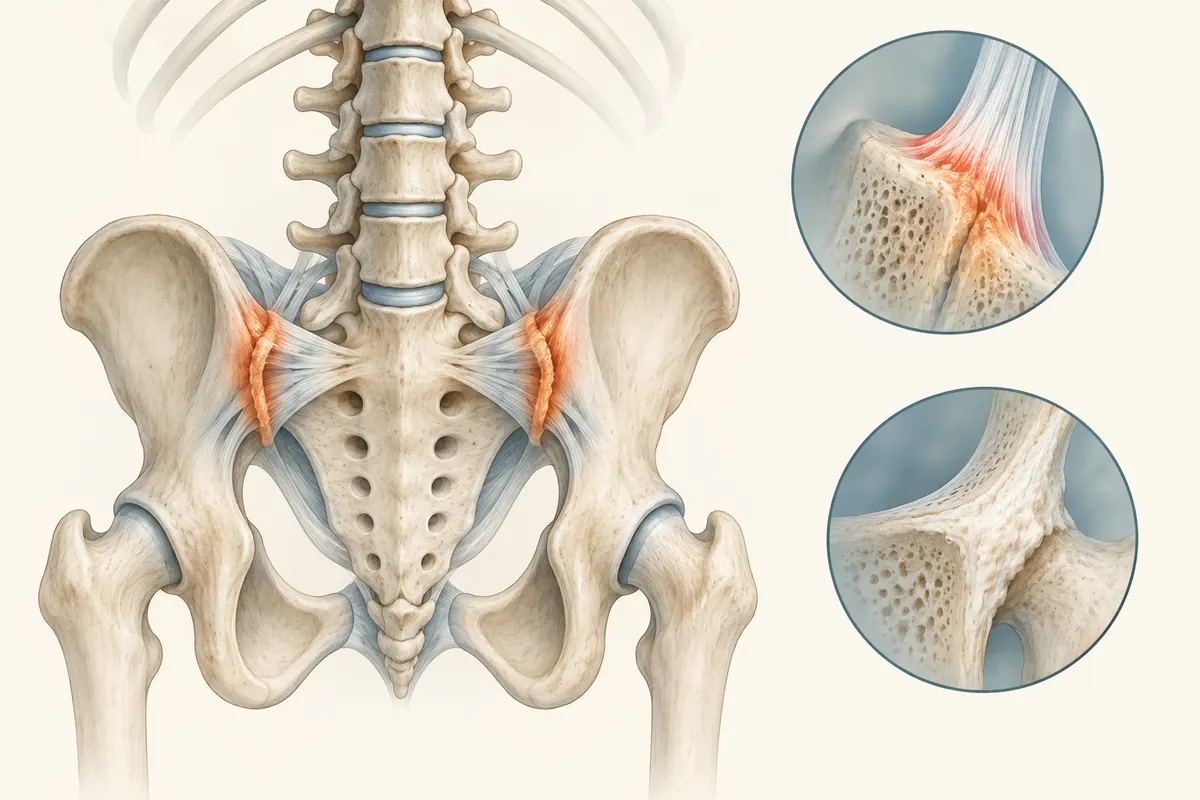
Ankylosing spondylitis is a form of axial spondyloarthritis that can inflame the spine and sacroiliac joints. HLA-B27 is a genetic marker associated with higher risk, but many people who carry it never develop the disease, and some people with axial disease do not carry it. A positive result cannot diagnose ankylosing spondylitis or predict that a person’s spine will fuse. A clearer explanation separates the sites where inflammation occurs from the structural bone changes that may develop in some patients over time.
HLA-B27 is a risk association, not a diagnostic switch
HLA-B27 is a histocompatibility molecule involved in presenting protein fragments to the immune system. The National Institute of Arthritis and Musculoskeletal and Skin Diseases (NIAMS) says that the gene increases the risk of ankylosing spondylitis, while emphasizing that many carriers never develop the condition and that genes and environmental factors may both contribute. Conversely, HLA-B27 is not present in every person with axial spondyloarthritis. The association provides population-level risk information; it does not establish whether one person currently has inflammation or how their disease will progress.
That distinction also matters when interpreting symptoms. Back pain and stiffness have many causes. A clinician may consider the pattern of inflammatory back pain alongside family history, other joint symptoms, or eye inflammation, but no single feature settles the diagnosis. History, examination, imaging, and laboratory results are interpreted together.
Enthesitis affects tendon and ligament attachment sites
An enthesis is where a tendon or ligament attaches to bone. Enthesitis means inflammation at that attachment. In axial spondyloarthritis, structures around the spine and pelvis may be involved. Inflammation in the sacroiliac joints, spinal joints, and supporting ligaments can contribute to pain and stiffness; involvement where ribs meet the spine can also make deep breathing difficult. The pattern and severity vary among people.
Enthesitis should not be presented as the starting event or sole cause in every patient. A 2025 specialist review discusses immune responses, tissue cells, and mechanical stress as parts of research into the disease, but many details remain hypotheses. Findings in animal models can help explore possible pathways; they do not by themselves prove that the same sequence occurs in humans.
From inflammation to new bone: related findings, unresolved sequence
Inflammation can affect joints and attachment tissues, causing pain and stiffness. In some patients, new bone forms at the edges of vertebrae as syndesmophytes. These growths can bridge adjacent vertebrae and reduce spinal flexibility, but fusion is not inevitable and progression varies. NIAMS notes that vertebrae may fuse in severe cases, not that this outcome is universal.
The specialist literature continues to examine whether inflammation directly drives new bone formation, whether bone growth follows after some inflammation subsides, and how these processes overlap at different sites. Imaging studies and experimental models help describe the relationship, but they have not resolved the cause or exact timing. Saying that inflammation automatically turns into bone, or that a single cytokine pathway explains every case, would overstate the evidence.
An expert perspective: separate observed links from proven mechanisms
A 2025 review in Frontiers in Immunology considers HLA-B27, immune signaling, tissue cells, and bone formation together, while stating that the cause of ankylosing spondylitis and the transition from inflammation to new bone remain unclear. This specialist synthesis supports an important reading rule: do not present one molecular pathway as a settled explanation. Clinically, HLA-B27 positivity is a risk clue, not a stand-alone diagnosis in someone without the broader clinical picture and not a forecast of an individual’s future.
Cell-signaling results and animal models can narrow the set of plausible explanations, but they do not guarantee a treatment response or predict an individual course. Structural changes and pain intensity may also evolve on different timelines. Keeping these distinctions visible respects scientific uncertainty and reduces the risk of interpreting a genetic test as a personal verdict.
Symptoms and test results need clinical interpretation
Persistent low-back or buttock pain that worsens with rest and improves with movement, morning stiffness, or symptoms involving joints, eyes, or the gut can be reasons to seek medical evaluation. These features are not a self-diagnosis checklist; clinicians must distinguish axial spondyloarthritis from other inflammatory and mechanical causes. Diagnosis draws on the history and examination and, when appropriate, blood tests and imaging. HLA-B27 may contribute information, but the result alone is not conclusive.
This article cannot diagnose an individual’s symptoms or test results. Seek medical advice for persistent pain or new symptoms such as eye pain or vision changes, or difficulty breathing. Treatment and follow-up depend on the person’s symptoms, other conditions, imaging, and clinical assessment.