ALS Motor-Neuron Degeneration and Breathing: Following the Pathways
How motor-neuron loss can affect movement and breathing, why symptom sequences vary, and why population-level explanations do not determine an individual diagnosis or prognosis.
Publication & corrections: infostoa · Editorial standards
Individual author and specialist reviewer information is not provided for this article.
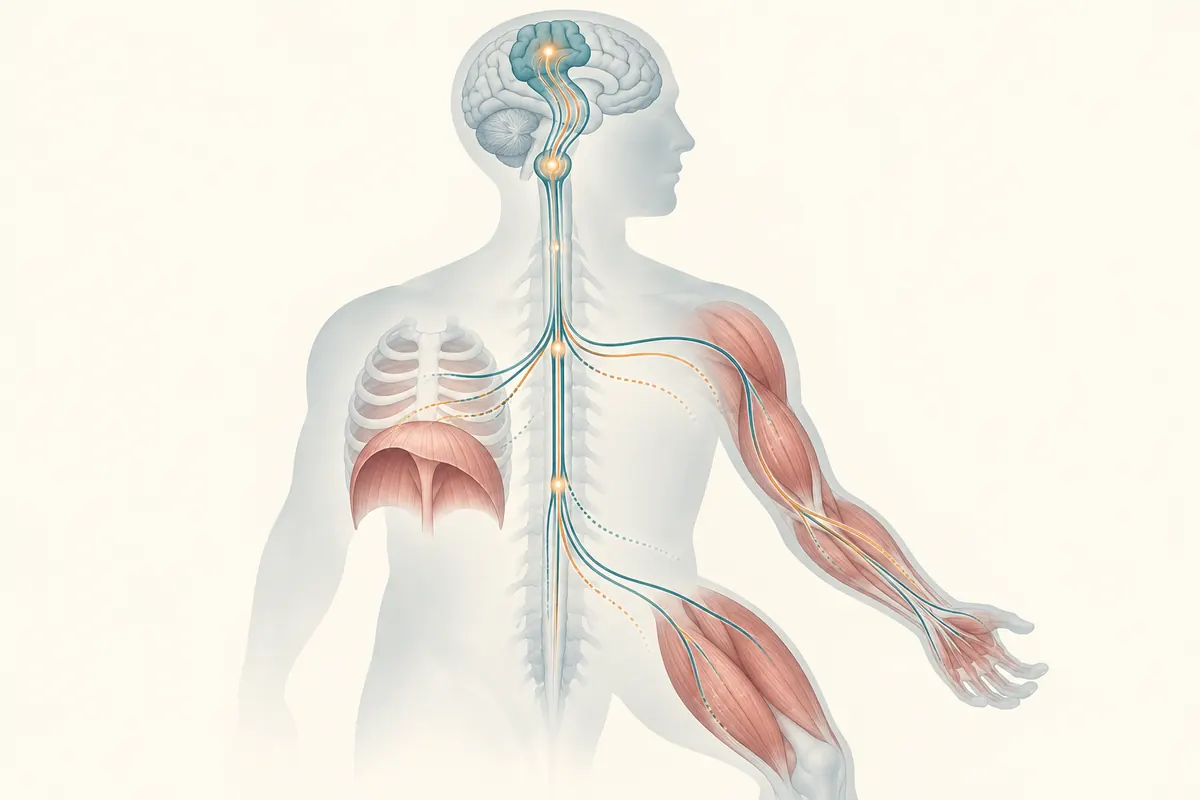
Amyotrophic lateral sclerosis (ALS) is a neurological disease in which motor neurons that control voluntary movement and breathing progressively degenerate. Muscles that lose their nerve input can weaken and waste away, and speaking, swallowing, coughing, or breathing may become difficult. Anatomy explains affected functions, not an individual course.
A motor signal travels from the brain to muscle
Signals for voluntary movement originate in the brain’s motor areas and travel through pathways in the brainstem and spinal cord before reaching muscles. Clinicians often describe an upper motor-neuron system in the brain and a lower motor-neuron system that connects through the brainstem and spinal cord to peripheral muscles. The 2024 European Academy of Neurology (EAN) guideline describes progressive motor-neuron loss in the motor cortex, brainstem, and spinal cord, associated with muscle weakness, stiffness, and wasting. Which pathways are most affected first varies among people.
When motor neurons no longer provide effective signals, muscles do not receive normal instructions to contract. The National Institutes of Health (NIH) describes weakness, muscle twitching, cramps, and atrophy, with possible effects on speech, chewing and swallowing, coughing, and breathing as ALS progresses. None of those features on its own establishes a diagnosis. Other conditions can produce overlapping symptoms, so clinical assessment is essential.
Symptoms do not follow one fixed sequence
Some people first notice weakness in an arm or leg; others initially have difficulty speaking, chewing, or swallowing. People with the same diagnosis do not necessarily notice the same change first or experience the same course afterward. It is more accurate to understand motor pathways as connected segments whose loss can appear in different activities than to infer a personal trajectory from a simplified “upper first” or “lower first” sequence.
ALS is also not best described as every kind of nerve function disappearing at once. Its core effects concern motor neurons and voluntary muscle control, while cognitive or behavioral changes can occur in some people and are discussed separately in the EAN guideline. The range of possible features should not be turned into a prediction for every patient. This article explains disease mechanisms and related functions; it is not a diagnostic tool or an individual prognosis.
Why breathing needs its own attention
Breathing muscles also depend on motor-neuron signals. As those signals weaken, a person may become short of breath during activity, have difficulty breathing at night or while lying down, or find it harder to cough effectively. NIH describes these as possible respiratory effects of ALS. They are not merely a side note to limb weakness: breathing function calls for its own clinical assessment and support planning.
The EAN’s 2024 guideline includes respiratory support among the areas of ALS management it reviews. It also notes that evidence is limited for many clinical questions and that regional differences in care organization matter. That is why one universal testing schedule or device threshold should not be inferred from a general explainer. Monitoring and support are decided in context, based on a person’s condition and preferences, the treating team’s assessment, and local services. Sudden or severe breathing difficulty requires urgent medical guidance rather than interpretation from general information.
Specialist perspective: separate anatomy from care decisions
The EAN guideline was developed with neuromuscular specialists across multiple countries, patient representation, systematic reviews, and GRADE assessment. It describes the neurological basis of ALS while separately evaluating recommendations for respiratory and nutritional support, multidisciplinary care, and areas where evidence remains scarce. This distinction matters: explaining why a motor pathway affects a function is not the same as deciding when a person should use a particular intervention. The guideline itself warns that the evidence base and regional care arrangements vary; individualized choices belong with the patient and clinical team.
Do not confuse diagnosis with prognosis
There is no single test that definitively diagnoses ALS. NIH describes a clinical process that combines medical history and neurological examination with tests such as electromyography, nerve-conduction studies, and imaging that may help assess the nervous system or rule out other conditions. This describes how clinicians investigate a case; it is not a checklist for diagnosing oneself from a symptom list.
A group statistic or a typical course also cannot calculate an individual’s future. Functional change, respiratory status, other health conditions, preferences, and access to support differ. Evidence and available care evolve as well. This article is an educational explanation of motor-neuron degeneration and respiratory involvement, not personal medical advice. Anyone concerned about symptoms or a rapid change should contact a qualified health professional who can evaluate the individual situation.