Amyloid-Beta Cascade and Tau Neurofibrillary Pathology in Alzheimer Disease
A careful guide to where amyloid plaques and tau tangles form, how they relate to neuron function, and why their causal sequence remains an active research question.
Publication & corrections: infostoa · Editorial standards
Individual author and specialist reviewer information is not provided for this article.
Alzheimer disease is associated with two well-known brain changes: deposits of beta-amyloid fragments between cells and twisted fibers of tau protein inside cells. These plaques and tangles are important research findings, but they do not establish a simple, universal sequence in which one lesion explains every later symptom. The National Institute on Aging (NIA) and the Alzheimer’s Association describe Alzheimer disease as a condition involving interacting biological changes and risk factors, with important questions still unresolved.
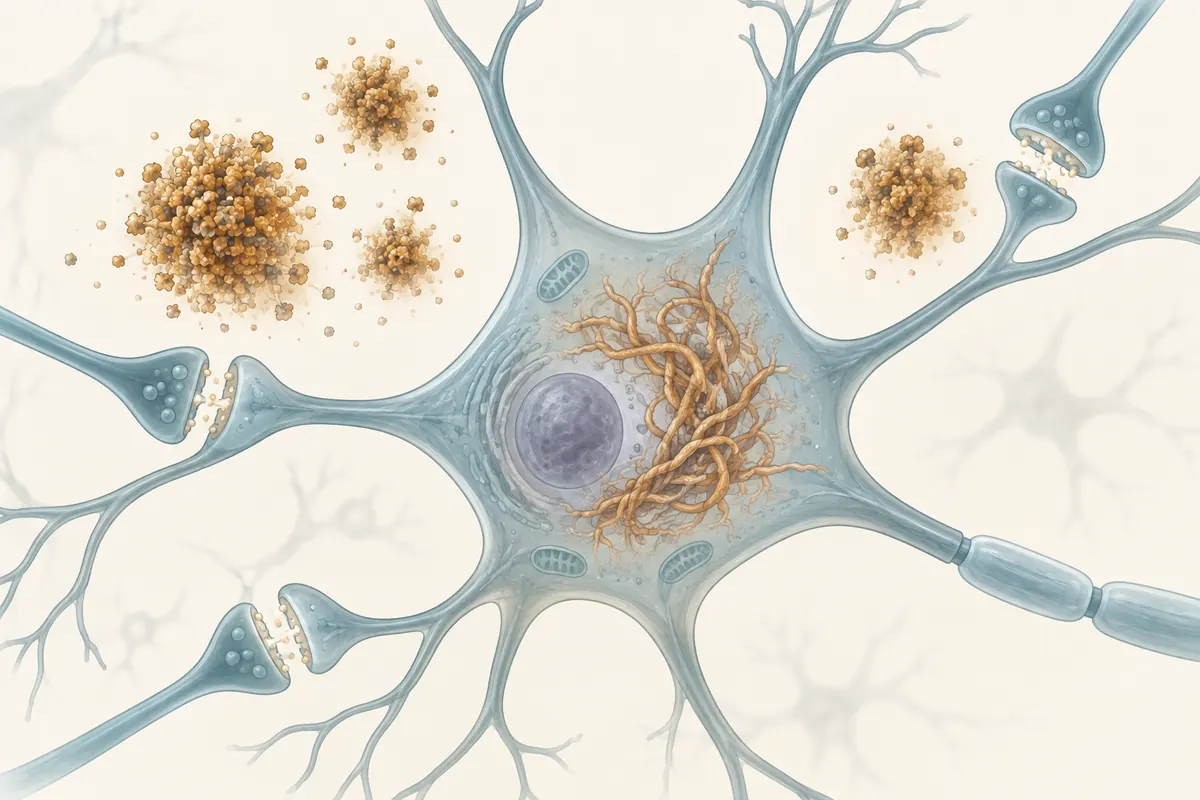
Two proteins, two cellular locations
Beta-amyloid is a small protein fragment produced when amyloid precursor protein (APP) is processed. In Alzheimer disease, some fragments accumulate in brain tissue and form plaques, largely in spaces between neurons. Tau is a different protein normally associated with microtubules inside cells. In disease, tau can lose its normal location and organization and form abnormal fibers that appear as intracellular tangles. The two findings are therefore not simply the same material collected in two shapes: they involve different proteins and different parts of the neuron.
This description helps explain what researchers observe under the microscope. It does not mean that an individual’s memory problems can be diagnosed from a plaque or tangle alone. Changes in memory, language, or judgment can have other neurological, medication-related, sleep, mood, or physical contributors. A clinical assessment must consider the person and the pattern of change, rather than infer diagnosis from one marker.
Why communication and cell survival matter
Neurons form networks that send signals, move materials, manage energy, and remove waste. Plaques and tau tangles are considered plausible contributors to disrupted communication and cell injury. Yet scientists have not settled which changes begin the process, which arise downstream, or why trajectories differ among people. The Alzheimer’s Association calls plaques and tangles prime suspects in neuron damage while explicitly noting that their precise roles are not known. That separates a plausible mechanism from a proven cause.
Amyloid-related changes may be detectable before obvious cognitive symptoms. A positive biological marker does not, by itself, show that dementia has begun or predict an identical rate of progression. A lesion, a person’s present abilities, and a forecast of future decline are related but different kinds of information.
The amyloid cascade is a model, not the whole answer
One influential research model places an imbalance in amyloid production or clearance early in the disease process, followed by tau changes and neuronal dysfunction. This framework organizes evidence but does not prove that everyone follows one pathway. As NIA explains, age, genetic susceptibility, and other biological processes also matter. Researchers therefore investigate interactions among inflammation, vascular health, metabolism, immune activity, and additional mechanisms rather than treating one protein as a complete explanation.
When reading treatment research, separate the measures. Check the disease stage studied, comparison group, follow-up period, and whether the outcome was a biomarker or cognition and daily function. A group average does not predict an individual’s treatment benefit or future course. Discuss treatment options and risks with the treating clinician.
Questions that make a study easier to interpret
When reading plaque or tangle research, ask whether it observed or tested causation, whether it studied cells, animals, or people, and what stage and outcome it measured. Laboratory findings are not automatic predictions about individuals.
Also separate association from causation. Plaque burden, tau distribution, neuronal injury, and cognitive test scores may change together; that alone does not establish which change came first or rule out other influences. Causal claims require evidence about timing and alternatives. Comparing study types and clinical trial outcomes helps judge whether a pathway matters to patients.
When symptoms deserve evaluation
Memory difficulty is not specific to Alzheimer disease. Repeated changes in memory or thinking that interfere with daily life deserve medical evaluation so that the cause can be assessed. Symptoms cannot reveal an individual’s plaque or tau status, and an online explanation cannot substitute for diagnosis. A clinician considers history, medicines, functional changes, and appropriate tests.
Amyloid and tau remain central clues to Alzheimer research. The careful conclusion is that both structures are observed and are associated with neuronal injury, while their precise causal roles and interactions continue to be studied. Keeping that uncertainty visible makes the biology more accurate, not less useful.