Requesting Disability and Mobility Assistance for Air Travel
How to describe, confirm, and document assistance across booking, the airport, boarding, and arrival, with EU and UK guidance kept within its jurisdiction.
Publication & corrections: infostoa · Editorial standards
Individual author and specialist reviewer information is not provided for this article.
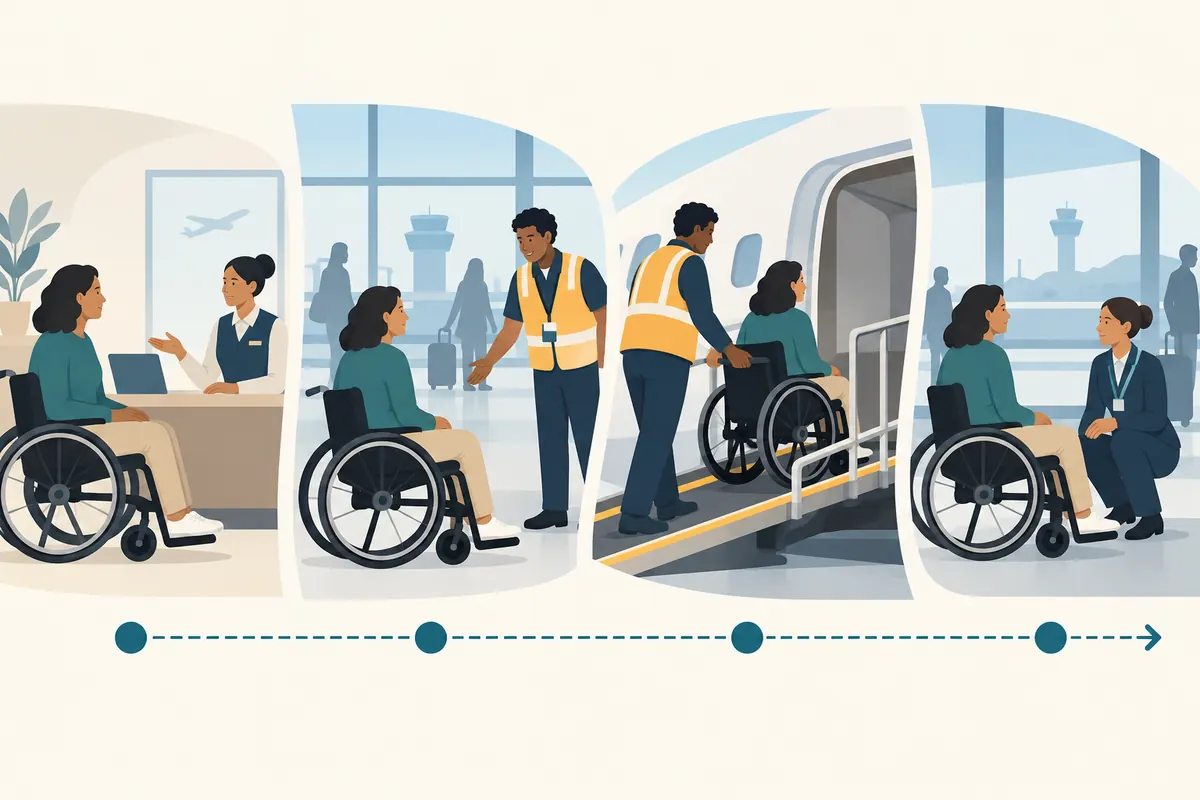
If you need a wheelchair, airport mobility, or communication support, arrange assistance before travel. Describe the tasks you need help with and keep a written confirmation. The rules and procedures depend on the route, operating airline, and applicable jurisdiction. The European Union’s passenger-rights guidance and the UK Civil Aviation Authority’s (CAA) practical guidance are not one worldwide rule and should not be blended into a universal promise.
Request early and confirm what was recorded
The UK CAA advises passengers to request assistance when booking or, if possible, at least 48 hours before departure through the airline, travel agent, or tour operator. Late notice can mean delays or support that is not ready. If an online booking form has no obvious assistance option, ask whether a separate call or form is needed. Keep the response with the booking details, then confirm before departure that the request remains attached to the current itinerary.
Treat the 48-hour point as the CAA’s preparation advice for the UK process. It does not establish a legal guarantee for every journey or promise that a particular service will be available merely because the request was submitted on time. EU rights guidance has its own scope and exceptions. For a journey with connections or multiple operating airlines, ask each carrier and airport which process applies to its segment, especially after a schedule, aircraft, or airport change.
Describe the assistance as concrete tasks
A general statement such as “I need help” may not tell staff what to arrange. Explain, as relevant, how far you can walk, whether you can use stairs, what type of wheelchair or powered mobility aid you use, whether you need help transferring to a seat, and what communication format works for you. Tell the airline about equipment or medical circumstances it specifically needs to assess, such as a powered wheelchair or a condition requiring extra care. Ask what documents or safety checks are needed; avoid sharing health details that are not required for the request.
Confirm the journey in segments: where to meet assistance at a terminal, car park, or public-transport arrival point; how help will work at check-in and security; how you will reach the gate and board; what transfer support is available to your seat; and when a mobility aid should be returned after landing. At a connection, ask about walking distance and how assistance is handed over between providers. If the flight time, aircraft, or connection changes, check that the original request still applies.
Know where airport help ends and in-flight care begins
The CAA describes examples such as airport transfers, support through security, boarding, seating, and movement through the destination airport. That assistance should not be assumed to include every personal-care task. The CAA says airline staff should assist with movement to the toilet if needed, but are not expected to help with eating, drinking, taking medication, or using the toilet itself. If you need one of those forms of support, ask the airline before travel whether a companion or another care arrangement is necessary.
Separate rules may apply to assistance dogs, oxygen, medicines, batteries, and powered wheelchairs. Submitting an assistance request does not automatically mean those items have been cleared for carriage. Prepare the equipment’s battery type and dimensions, whether it can be dismantled, and any relevant documentation, then confirm the operating airline’s current requirements. Safety procedures can change, so a previous trip is not reliable proof of today’s process.
Practitioner perspective: distinguish rights from operational arrangements
The European Commission’s Your Europe page helps explain passenger rights within the EU regime. The CAA’s detailed page explains how to request UK assistance and what support may look like across airport and flight stages. Together, they point to a useful distinction: a right to assistance and the practical information needed to organize that assistance are related but not identical. Jurisdiction can change the rules, exceptions, and notice expectations. First identify the regime for each segment; then tell the airline what tasks, equipment, and handoffs are needed and obtain written confirmation. Confirmation supports preparation, but it is not a guarantee that every request will be fulfilled in precisely the same way in all circumstances.
Keep a factual record if help is missing
If assistance is delayed or absent, record the time, place, booking reference, service requested, what happened, and the staff or desk contacted. Keep booking confirmations and messages. If you cannot move safely, tell the airport assistance point or airline staff before trying to continue alone. The UK CAA provides a route for reporting assisted-travel problems; it is not an emergency medical or rescue service. The appropriate complaint route depends on the airline and the departure or arrival jurisdiction.
Keep contact details and meeting points together and share them with a companion if useful. Crowding, equipment issues, and safety restrictions can still alter the plan. A confirmed request is not a promise of an unchanged itinerary.