Giving a Historic Place a New Use Without Losing Its Living Meaning
A practical process for considering a historic building’s physical fabric alongside the community practices and relationships that continue there. It separates conservation guidance from local legal approvals.
Publication & corrections: infostoa · Editorial standards
Individual author and specialist reviewer information is not provided for this article.
A new café, gallery, or community use cannot be judged by how much of a historic building’s exterior remains. Ask what memories and relationships it holds, who still uses it, and how new operations might change those connections. Start by documenting significance, involving communities, comparing changes, and reviewing the place after opening.
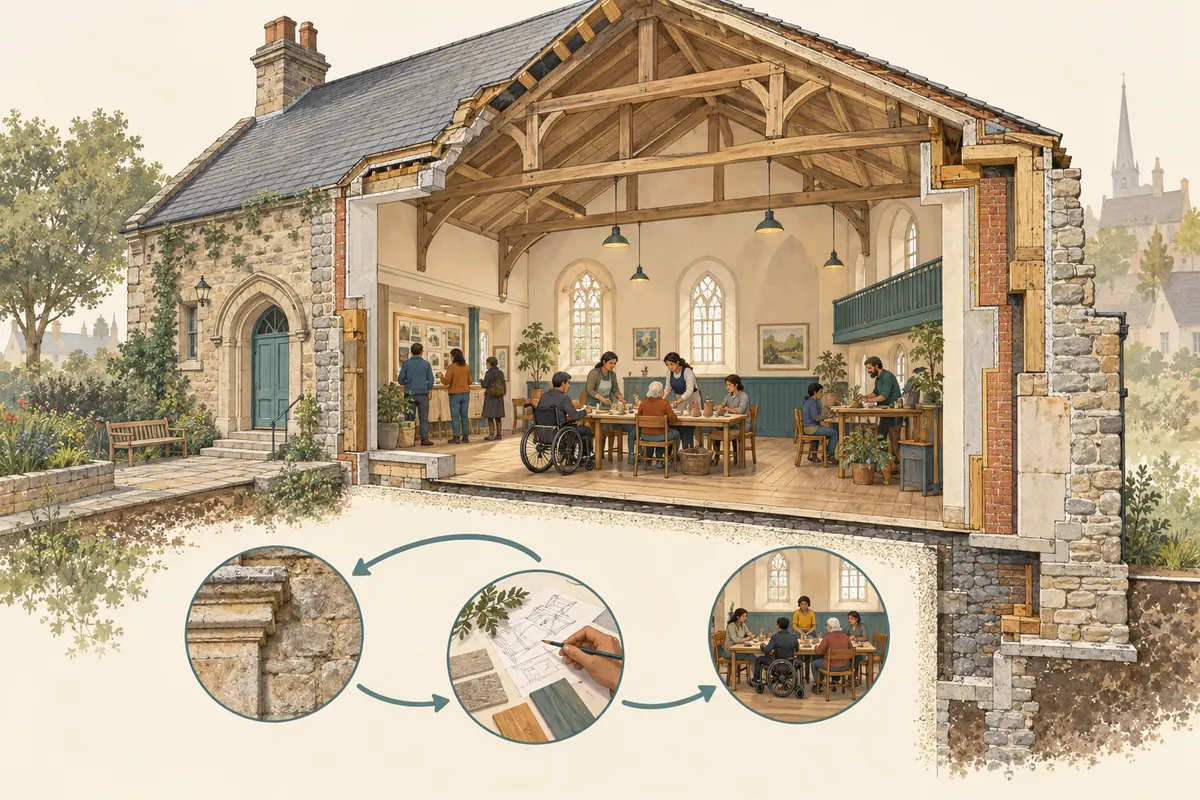
Record the building and the meaning of the place
Begin with the physical record: the building’s history, materials, structure, and features. Then identify practices, skills, memories, gatherings, and everyday uses connected to the place. These records overlap, but they are not interchangeable. A project can preserve old walls while displacing an activity that still happens there; new equipment may also be added without ending an important practice. Record what matters, to whom, and why, while separating evidence from uncertainty.
No single group necessarily speaks for everyone. Owners, long-term users, nearby residents, tradition bearers, and visitors who need access support may value the place differently. Ask who is missing from decisions, and whether recording or publishing a practice could expose people or reveal something they do not want shared.
UNESCO’s intangible-heritage convention describes practices, knowledge, and skills that communities transmit and continue to recreate. Article 15 encourages participation by the communities and people who create, maintain, and transmit them. This supports involving practitioners when interpreting a place; the convention is not a building permit or engineering standard.
Compare the new use with what matters
List what each use requires—such as restrooms, an entrance route, fire egress, climate control, lighting, or staffing. Compare each requirement’s effects on historic fabric, access, and ongoing practices. Separate essentials from conveniences; different locations or equipment may meet the need with less impact.
Australia ICOMOS’s Burra Charter starts with understanding and documenting cultural significance, then sets policy and manages the place accordingly. Ask both what should be conserved and how a change affects who can use the place and what they do there. A new entrance route may change both fabric and gathering patterns. The charter is professional guidance, not local heritage, building, fire, access, or land-use law.
Make participation part of the decision
Do not wait until the plan is finished to ask for approval. Involve communities and existing users before the program and design are fixed. Ask which activities should continue, whether hours or fees create barriers, and whether construction needs an alternative space. Then explain what changed and why a suggestion could not be adopted.
The format matters. A public meeting on a weekday afternoon may exclude people with caregiving duties, shift work, mobility barriers, or different language needs. Combine options such as short individual interviews, small-group sessions, written or online feedback, interpretation, and accessible meeting locations. Ask permission before sharing stories or attributing a view to a person. If the same community members are repeatedly asked to provide unpaid work, consider compensation for their time and costs.
Document trade-offs and what remains uncertain
Compare each option against cultural significance, safety, accessibility, maintenance, cost, and operational feasibility. If every proposal must meet a fire-safety requirement, ask which one changes less historic fabric, leaves more time for an existing practice, and can be maintained with realistic resources. Avoid framing the result as a simple win for “preservation” or “use.” Explain whose values were considered and what loss, disagreement, or uncertainty remains.
Keep a decision record with the date, participating groups, evidence reviewed, alternatives considered, chosen changes, mitigation measures, and status of local approvals. If evidence is missing or community views differ, record that disagreement instead of smoothing it away. A lack of response is not proof that a whole community agrees or objects.
Revisit the place after it reopens
When the new use begins, check whether the assumptions made during planning were right. Ask whether existing gatherings or skill-sharing continue, whether reservations, security rules, or hours exclude some people, and whether visitors can understand the place’s significance. Set a person responsible for follow-up and a date to review concerns. Construction may finish on a fixed schedule; living practices and patterns of use can continue to change.
Adaptive reuse neither freezes the past nor empties a place of meaning. It records what matters, includes the people who carry it forward, and checks how design and operation affect them. UNESCO’s convention and the Burra Charter inform that work; local permits and legal duties still require separate review.