Planning an Accessible U.S. National Park Visit: Check the Whole Route
Plan a U.S. national park visit by checking transportation, parking, paths, restrooms, and visitor services as one route. Learn how to separate design standards from conditions on the day.
Publication & corrections: infostoa · Editorial standards
Individual author and specialist reviewer information is not provided for this article.
“Is this national park accessible?” is too broad to plan a particular day. Parking, shuttles, trail conditions, and restroom hours are separate facts. Choose a park and date, trace the actual route, and ask staff about details the published information leaves open.
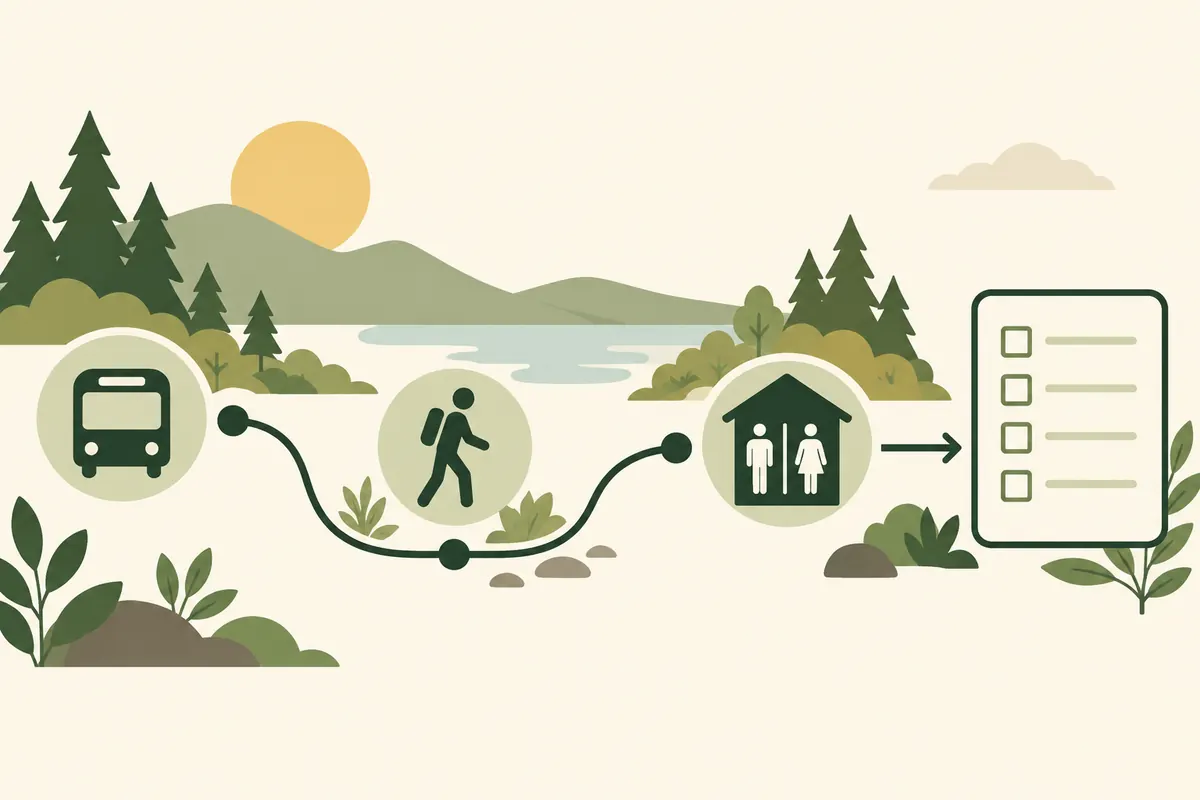
Start with the conditions that matter to your trip
Needs differ: a mobility-device user may check surface, grade, thresholds, and turning space; someone who walks short distances may focus on rest points and restroom gaps. Hearing or vision support, sensory conditions, service animals, and equipment may raise other questions. Use the list to compare information with your own needs, not to judge whether another person can visit.
Track these items in one itinerary:
- transport, parking, and accessible spaces;
- shuttle or boat dates and boarding details;
- distances, rest points, and turnaround locations;
- trail surface, grade, width, obstacles, and restrooms;
- facility and program hours; and
- closures, construction, weather notices, and a park contact.
The point is to avoid assuming that every park has the same facilities or answers. The National Park Service (NPS) says services and facilities vary by park. It directs visitors to the individual park’s information and encourages people to contact that park ahead of time about support they may need (NPS accessibility planning).
Check continuity from transportation to the destination
An accessibility page may not cover each connection. Check the route from parking to the first stop; confirm shuttle dates, stops, and boarding arrangements; and, for a boat tour, ask about the dock, waiting area, restroom, and path after landing. One usable segment does not prove the whole route connects.
A short distance on a map can still involve elevation changes, unpaved sections, water crossings, or stairs. Use the map to choose possible routes, then use current park notices or a direct call to check surface conditions, construction, and detours. You can ask whether parking is close to the shuttle, whether there is somewhere to sit along the way, or how far the restroom is from the planned stop. Concrete questions make it easier to match an answer to your itinerary.
Ask about trail segments, not just trail labels
Labels such as “easy” or “short walk” do not reveal a trail’s grades or surface. The U.S. Access Board’s ABA guide for outdoor developed areas describes trail characteristics such as surface, clear width, obstacles, running and cross slope, resting intervals, and signs within the guide’s federal scope. It gives visitors a framework for asking about conditions that may matter to their own mobility and equipment. The guide is a design standard for specified ABA facilities and projects. It does not, by itself, define every ADA duty for state, local, or private entities, and it cannot guarantee the condition of a trail on a particular day.
If a park page provides no measurements, ask for the details you need instead of only asking, “Can a wheelchair use this trail?” Useful questions include the start and end points, round-trip distance, steepest segment, surface material, condition after rain, roots or thresholds, rest areas, and places to turn around. If width or turning space matters for your device, say so. You are asking for observable information to make your own decision, rather than asking staff to make a blanket judgment about you.
Put restrooms and indoor facilities on the itinerary
A restroom may appear on a map but still have limited hours, a seasonal closure, or construction nearby. Record its location and operating hours alongside the distance between stops. At a visitor center or exhibit, check more than the entrance: consider the route from parking or the shuttle, seating, elevators, accessible formats for visitor information, and support available for programs. If you are camping, compare the reservation description with the on-site grade and surface and the route to the restroom. Standardized facility descriptions may leave out a detail important to your visit, so confirm the high-priority items with the park.
A cross-sectional study audited 50 free Delaware community parks for accessibility, usability, and playground safety. It highlights why a feature’s condition and route connections matter, but it did not study national parks and cannot describe your destination. Use it only as context for questions to ask locally.
Recheck the plan shortly before you go
Before departure, review notices about construction, road or trail closures, shuttle changes, and weather. Identify an alternate stop and decide in advance when you would turn back. When contacting the park, include your date and route and ask for the specific missing facts. For example: “What are the surface and steepest section between the visitor center and this trail?” or “What time does the restroom close, and is there a construction notice?” Keep confirmed details separate from unanswered questions.
Access is not a measure of effort; confirm needed support with the park.
Accessibility specialists assess the connected route. ABA outdoor standards cover specified federal settings, not every trail; confirm current park details.